
DIWASS waste notification – how the process is changing?
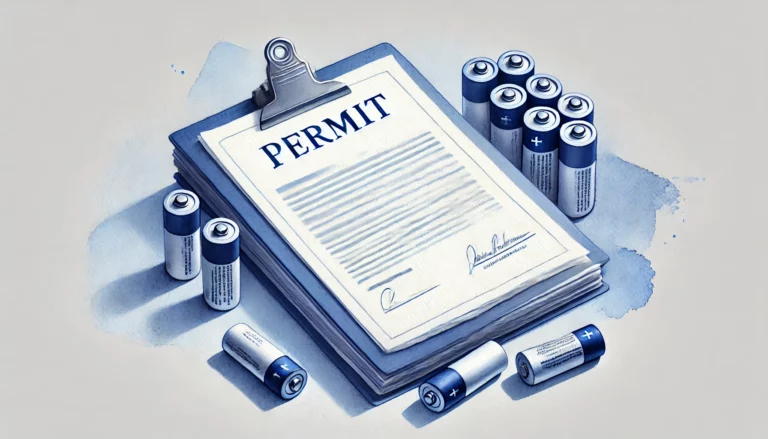
From 21 May 2026, the DIWASS waste notification replaces the previous paper-based document flow in transboundary shipments of waste (TSW). The change is based on Regulation (EU) 2024/1157, which repealed Regulation (EC) No 1013/2006. In practice, this means one mandatory electronic channel for notifications, decisions and confirmations.
Have any questions about registering with DIWASS? Contact us:
e.nadolna@ekologistyka24.pl , +48 881 045 376
j.blazewicz@ekologistyka24.pl , +48 500 867 153
Or click HERE to learn more
The current process – how notification worked before DIWASS

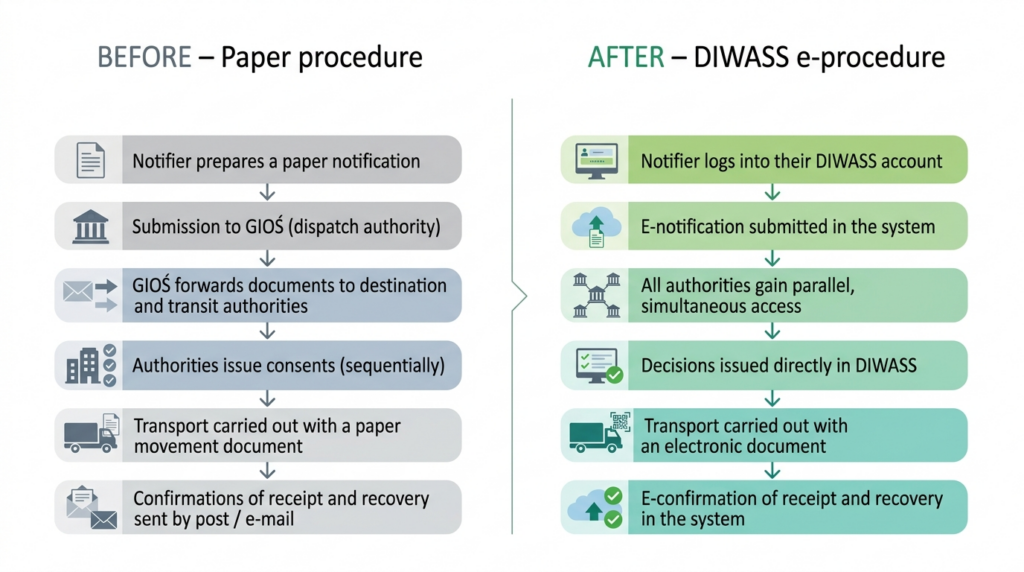
Until now, the prior written notification and consent procedure (PIC) relied on paper. The notifier prepared a notification document and a movement document, and then submitted them to the authority of the country of dispatch – in Poland, to GIOŚ (the Chief Inspectorate of Environmental Protection). GIOŚ then forwarded the documentation to the authorities of the countries of destination and transit. Only after all authorities had granted their consent could the shipment begin, and each transport was accompanied by a paper movement document. Confirmations of receipt and recovery, meanwhile, circulated by post or e-mail.
This model had clear weaknesses. Data was scattered between authorities and companies, so discrepancies arose easily. Moreover, the paper workflow extended deadlines and increased the risk of formal errors.
The process after DIWASS – a fully digital notification
After 21 May 2026, the entire notification path moves into the DIWASS system, operated by the European Commission. What changes above all is the way of working:
- Registration instead of ad hoc forms. Every TSW participant (notifier, carrier, consignee, facility) must have a DIWASS account, created via EU Login. In Poland, registration is approved by GIOŚ after verifying the entity’s data.
- Entity data only from a list. The system does not allow the details of shipment participants to be typed in manually. They are selected from a drop-down list, so a business partner not registered in DIWASS blocks the submission of the document.
- Electronic notification and decisions. The notification document, the movement document and correspondence with the authorities of all countries flow through a single system. As a result, every authority and participant sees the same, up-to-date status of the procedure.
- Digital confirmations. Receipt of the waste and completion of recovery or disposal are confirmed electronically, closing a full audit trail.
Importantly, shipments carried out under consents issued before 21 May 2026 are still settled under the old rules. In such cases, movement documents are not entered into DIWASS but sent to GIOŚ instead.
Information flow – before and after
What this means for companies?
The DIWASS waste notification rewards well-ordered data. Registration numbers, entity roles and facility information must be consistent across the entire chain, because the system verifies them automatically. As a result, the procedure becomes faster and more predictable. At the same time, DIWASS does not replace BDO (the Polish Waste Database) – both obligations run in parallel.