Waste transport to the Netherlands – what permits are required?
Transporting waste from Poland to the Netherlands requires strict adherence to EU and national environmental regulations to avoid costly penalties and delays. A key part of the preparation involves verifying the cargo status and ensuring all entities are registered in the appropriate administrative systems. This article details the procedures and documentation necessary to ensure that such logistical operations are fully compliant with Dutch law.
If you’re moving waste to or through the Netherlands, don’t leave compliance to chance
Secure your Dutch waste transport permit quickly and without unnecessary complications. We handle the process end-to-end — from document verification to submission — so you can stay focused on your operations.
Contact us today and get your permit handled right the first time.
e.nadolna@ekologistyka24.pl , +48 881 045 376
j.blazewicz@ekologistyka24.pl , +48 500 867 153
International waste transport and EU law
Regulation (EC) No 1013/2006 (soon to be fully replaced by Regulation (EU) 2024/1157) is the basic legal act regulating the movement of waste between EU Member States. This document defines the supervision and control procedures which depend on the type of load and its destination. These regulations divide waste into different categories, thus imposing specific information obligations on transport companies. Therefore, every operation involving waste transport to the Netherlands must begin with a thorough analysis of this regulation.
In fact, the Union regulation aims to unify safety standards across the whole of Europe. It imposes an obligation on entities to ensure that waste reaches installations with the appropriate permits for processing. Moreover, these regulations force market participants to hold a financial guarantee in specified cases. Consequently, member states can secure funds in case they need to neutralize waste during emergency situations.
The VIHB system – a key requirement in the Dutch market
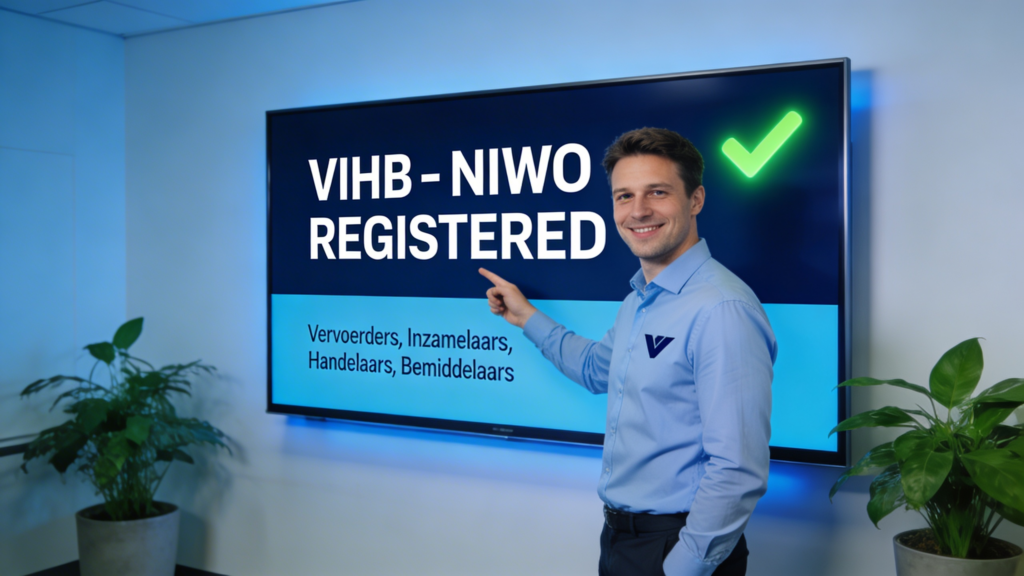
Every company planning waste transport to the Netherlands must register in the VIHB system. This name is an abbreviation for the Dutch words representing:
- Vervoerders (Carriers)
- Inzamelaars (Collectors)
- Handelaars (Traders)
- Bemiddelaars (Brokers)
The NIWO foundation manages this registration and enters the entity onto the official list after a positive verification process. Lack of a valid VIHB entry during a roadside inspection in the Netherlands results in an immediate vehicle stop and a heavy fine.
The process of obtaining a VIHB certificate requires submitting documents that confirm the reliability and integrity of the enterprise. Dutch authorities primarily check whether the company possesses the appropriate professional competencies to manage waste. Therefore, carriers should handle this formal step well in advance of the planned departure date. Holding a VIHB number serves as proof that the company operates according to the rigorous environmental protection standards applicable in the Netherlands.
Waste classification: Green List and Amber List
Correct load classification determines the complexity of the administrative procedures. The following table summarizes the key differences:
| FEATURE | GREEN LIST | AMBER LIST |
| Risk level | Low (paper, glass, plastics) | High / Hazardous waste |
| Procedure | General information procedure | Prior written notification and consent |
| Approval | Not required from authorities | Required from country of origin and country of destination, as well as country of transit, if included |
Waste from the Green List usually falls under the general information procedure, which significantly simplifies the logistics. These materials have a low risk level, such as sorted paper, glass, or certain plastics. Nevertheless, even in this case, waste transport to the Netherlands requires a specific set of documents to be present in the driver’s cabin.
The situation becomes more complicated when the waste appears on the Amber List or is classified as hazardous. In such cases, the law requires a procedure of prior written notification and consent. This means that the competent authorities in both the country of dispatch and the country of receipt (and sometimes country of transit as well) must issue an official permit for the transport. This process usually lasts several weeks and requires providing detailed chemical composition analyses of the transported substances.
Documentation necessary during transport to the Netherlands
The most important document for Green List transports is Annex VII. This document must accompany the load throughout the entire route, from the loading site to the unloading point in the Netherlands. It contains data about the producer, the recipient, the exact weight, and the waste code according to the European catalog. Furthermore, the driver should carry confirmation of entry into the Polish BDO register, which confirms the legal right to transport waste.
In the case of a notification procedure, the key document is the movement document along with a copy of the decision from the relevant environmental authorities. The carrier must also remember to mark the vehicle properly with a plate containing the letter A. Although this plate is not always mandatory for all waste types in the Netherlands, transport routes often lead through Germany. There, the absence of such a sign constitutes a serious violation of road and environmental regulations.
Obligations of entities participating in the logistics process

Several entities simultaneously share the responsibility for waste transport to the Netherlands. The sender of the waste must guarantee that the description in the documents matches the actual state of the goods. In turn, the carrier is responsible for securing the load safely and delivering the documentation to the recipient on time. Effective cooperation between these links allows for the avoidance of errors that could result in turning the transport back at the border.
The recipient in the Netherlands has an obligation to confirm the receipt of the waste and provide information regarding its recovery or disposal. It is worth emphasizing that each party must store the transport documentation for a period of at least three years. Tax or environmental inspections can occur long after the completion of a specific order. Transparency in the flow of information builds the trust of the control authorities toward the given company.
Financial sanctions for the lack of appropriate permits
Dutch inspection services, such as the ILT, show very low tolerance for deficiencies in waste transport. Fines for lacking a VIHB entry can reach several thousand euros for the first violation. In the case of recidivism or transporting hazardous waste without the necessary notification, these amounts increase drastically. Additionally, authorities have the right to detain the vehicle in a secure parking lot until the matter is resolved, which generates extra costs for the carrier.
Furthermore, serious violations of the regulations can result in the revocation of the transport license or blacklisting the company. Therefore, the financial risk associated with neglecting formalities significantly exceeds the costs of obtaining the certificates. An entrepreneur should treat expenditures on legal advice and registration as an investment in operational safety. Avoiding penalties is not just about saving money, but also about protecting the brand’s reputation in the demanding European market.
WASTE TRANSPORT PERMITS ARE ONLY THE FIRST STEP.
WHAT WILL CHANGE FROM 21 MAY 2026?
From 21 May 2026, waste shipments involving an EU Member State will move to DIWASS. This means that having waste transport permits alone will no longer be sufficient. Shipment procedures and documentation will be handled electronically, including Annex VII documents and digital workflows related to notification procedures. Do not wait until the deadline. Act now and make sure your business is ready for compliant future shipments. Contact us for more information about DIWASS implementation:
e.nadolna@ekologistyka24.pl , +48 881 045 376
j.blazewicz@ekologistyka24.pl , +48 500 867 153
How to effectively plan waste transport to the Netherlands?
Effective planning starts with a thorough verification of waste codes and the legal status of the contractors. The entrepreneur should check if the Dutch recipient holds a current permit for processing a specific group of raw materials. Then, the carrier must prepare a complete set of transport documents, ensuring their legibility and substantive correctness. It is also good practice to train drivers regarding the procedures applicable during roadside inspections in the Netherlands.
Moreover, one should consider collaborating with a specialized consulting firm that can perform a documentation audit. Professional support allows for the quick acquisition of a VIHB certificate and the efficient execution of the notification procedure. Consequently, waste transport to the Netherlands proceeds smoothly and without unnecessary stress for the logistics team. Proper preparation serves as the foundation for success in the industry of international waste trade.
Author: Jakub Koszyński | Edited by: Paweł Makowski