Non-EU operators in DIWASS system: most common problems
Since 21 May 2026, DIWASS (the Digital Waste Shipment System) has been mandatory for cross-border waste shipments where an EU Member State is the country of dispatch, destination or transit. Registration opened on 21 April 2026. Companies operating outside their “home” Member State – and especially non-EU operators – hit most delays at the DIWASS registration stage. Here’s what trips people up.
Have any questions about registering with DIWASS? Contact us:
e.nadolna@ekologistyka24.pl , +48 881 045 376
j.blazewicz@ekologistyka24.pl , +48 500 867 153
Or click HERE to learn more
EU vs. non-EU: Two different paths
The biggest source of confusion is that your access route depends on which Member State is involved, not just on where your company sits.
Common mistake: Assuming a non-EU company must “log in and operate” the system. In practice, a third-country operator often just needs to appear as a selectable entity. The registration is a technical step, not a licence to ship.
EORI and VAT: Identification, not login credentials
DIWASS does not authenticate you with an EORI or VAT number – you log in via EU Login. Identification numbers still matter enormously at the registration stage, though.
Common mistake: Entering a VAT number where the authority expects a national waste or company registration number, or vice versa. Check the country-specific identifier list before you start the form.
User authorization: Become a user first
You cannot register a company until someone sets up a person as a DIWASS user.

- The individual submitting the request must first become a user of DIWASS via EU Login, then register the operator.
- Once you register an operator, it becomes selectable in any role – notifier, arranger, producer, carrier, consignee or facility. DIWASS manages access rights technically, but it does not enforce whether an operator may legally act in that role. The competent authority makes that assessment per notification.
Common mistake: Several people at the same company create duplicate operator records, or nobody sets up a valid EU Login account first. Either problem stalls the whole application.
Choosing the right approving authority
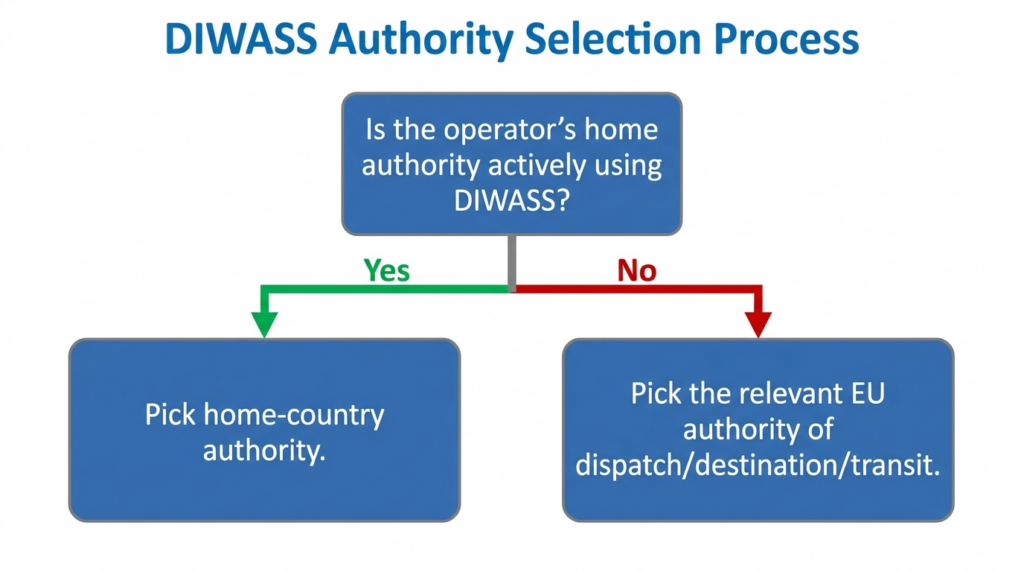
For every registration you must select the competent authority that will approve the request. Non-EU registrations most often go wrong here.

- Third-country operator, authority actively uses DIWASS: select the competent authority of the country where the operator holds its registered office.
- Third-country operator, authority does NOT actively use DIWASS: select the EU competent authority that would act as authority of dispatch, destination or transit for the planned shipment. As of 21 April 2026, no third-country authority yet used DIWASS actively – so most non-EU operators route their approval through an EU authority.
The most common rejections
An EU-backed authority approves each registration request. These recurring problems cause rejections:
- Wrong approving authority selected – for example, a non-EU operator picks its home authority when that authority isn’t active in DIWASS, instead of the relevant EU authority.
- Wrong or missing “main identification number” – the identifier doesn’t match what the chosen authority requires.
- Missing supporting documents – where an authority requires them, you must send them directly to that authority, outside DIWASS. Forgetting this leaves the request pending.
- Registering in the wrong channel – you submit via the DIWASS GUI when the Member State requires its interconnected national or local system, or the reverse.
- Incomplete basic data – you leave out the address or contact details that the authority needs to verify the operator.
Quick checklist before you submit
Still not sure how to proceed? Send us a message:
e.nadolna@ekologistyka24.pl , +48 881 045 376
j.blazewicz@ekologistyka24.pl , +48 500 867 153
Author: Jakub Koszyński | Edited by: Paweł Makowski